Returned Material in Metal Manufacturing | Masna3y Pro
Trace usable leftover material back to stock and into another order with a fictional quantity example, without assuming cutting optimization or automatic quality decisions.


Control metal manufacturing from raw material through the finished product
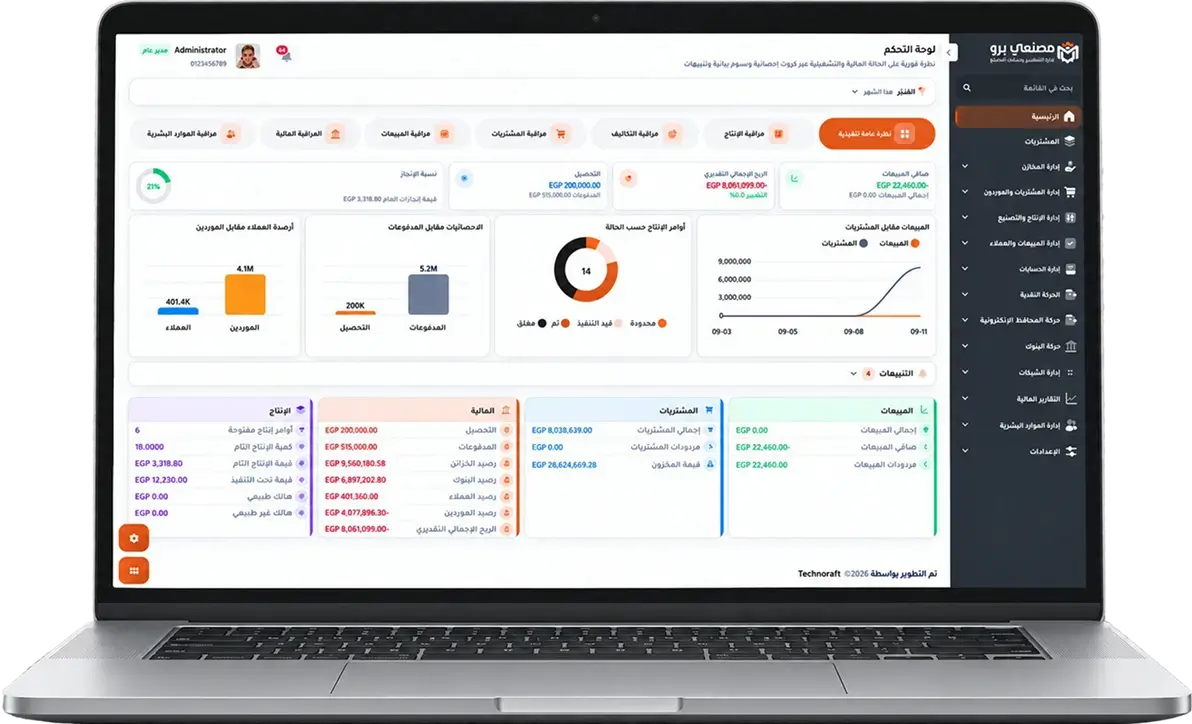
Connect materials, sizes, manufacturing orders, and cutting, forming, and assembly stages inside Masna3y Pro to follow every order, its consumption, and its cost.
-
1Track materials by type and size.
-
2Clear manufacturing-order execution stages.
-
3Link offcuts and waste to cost.



We understand size, cutting, and operating challenges in metal manufacturing that your factory faces.
Different material types, weights, and sizes make consumption control and offcut follow-up essential to knowing cost.

Overlapping materials and sizes
It is hard to follow weights, sizes, and types when manufacturing-order data is spread across multiple files.

Metal consumption variances
Material use can exceed plan because of cutting or rework without a clear reason.

Offcuts and waste
Offcuts and waste may not be linked to the production order, so true cost is missing.

Unclear manufacturing-order cost
It is hard to collect material, forming, and assembly cost accurately for every order.
Was usable leftover material returned to stock before the next order used it?
An operating order may leave material that can be used again. Moving it straight to another order without recording the return and new issue makes stock and both orders harder to reconcile. The question is about the material trail, not an assumed waste percentage.
Masna3y Pro includes inventory movements and item movement history, as well as additions and returns during production. Review the sequence from a return to a later issue. Keep material the factory has judged usable separate from waste with its own recorded reason and movement.
In a fictional scenario, the factory team reviews 8 kg of leftover material and considers it suitable for return. It is returned to stock, then 5 kg is issued to another order. Three kilograms remain from that returned quantity. The example makes no automatic quality decision and derives neither finished-product weight nor order cost.
Report example: separate issues, usable returns and scrap
Educational simulation with fictional quantities and references; not customer data or a system screenshot. The table illustrates how to read the data; it does not represent a ready-made sector report in this layout.
For fictional order SIM-MET-A, review one material in one unit of measure. Assume the 2 kg of scrap below belongs to the material already issued to this order, rather than an additional issue, and the factory team has assessed 8 kg as suitable for return.
| Entry | Quantity | How to read it |
|---|---|---|
| Issue to order A | 100 kg | Material movement from stock to the order |
| Usable return from A | 8 kg | Separate return movement to stock |
| Recorded scrap on A | 2 kg | Separate record with a reason and approval status; not a usable return |
Net issued after returns = 100 − 8 = 92 kg. This is neither finished-product weight nor proven productive consumption. Do not subtract scrap again and automatically label the remainder consumption. Issuing 5 kg of the return to SIM-MET-B is a separate movement; 3 kg remains from that returned quantity in this example, not necessarily the entire warehouse balance. An issue-versus-plan variance is not scrap without a supporting scrap record.
Understand how material movements relate to production cost
Must all material left after an operating order be recorded as waste?
No. Separate material the factory team has judged suitable for return from waste with a recorded reason and movement. Masna3y Pro includes returns during production, inventory movements and item movement history. We do not assume the system decides material suitability automatically.
Are cutting optimization or weighing-scale connections included?
These requirements need technical review before their availability or implementation can be confirmed. We first identify the equipment, required data and workflow, then define the relevant scope without assuming either function is included.
Review setup, training and support
Choose a simple example of a material issue, return and later issue so we can review the trail between orders and stock.
Returned Material in Metal Manufacturing | Masna3y Pro
Trace usable leftover material back to stock and into another order with a fictional quantity example, without assuming cutting optimization or automatic quality decisions.



