Garment and Textile Production Stages | Masna3y Pro
Review where garment-order quantities stand across operating stages and finished output, using a clearly fictional quantity example without double-counting.



Follow every model and size from fabric through the finished product
Masna3y Pro helps you connect fabrics, accessories, production orders, and cutting, sewing, and finishing stages so you can follow quantities and know the cost of every model.
-
1Clear quantities by model, size, and color.
-
2Follow production and delivery stages.
-
3Control fabric consumption and waste.


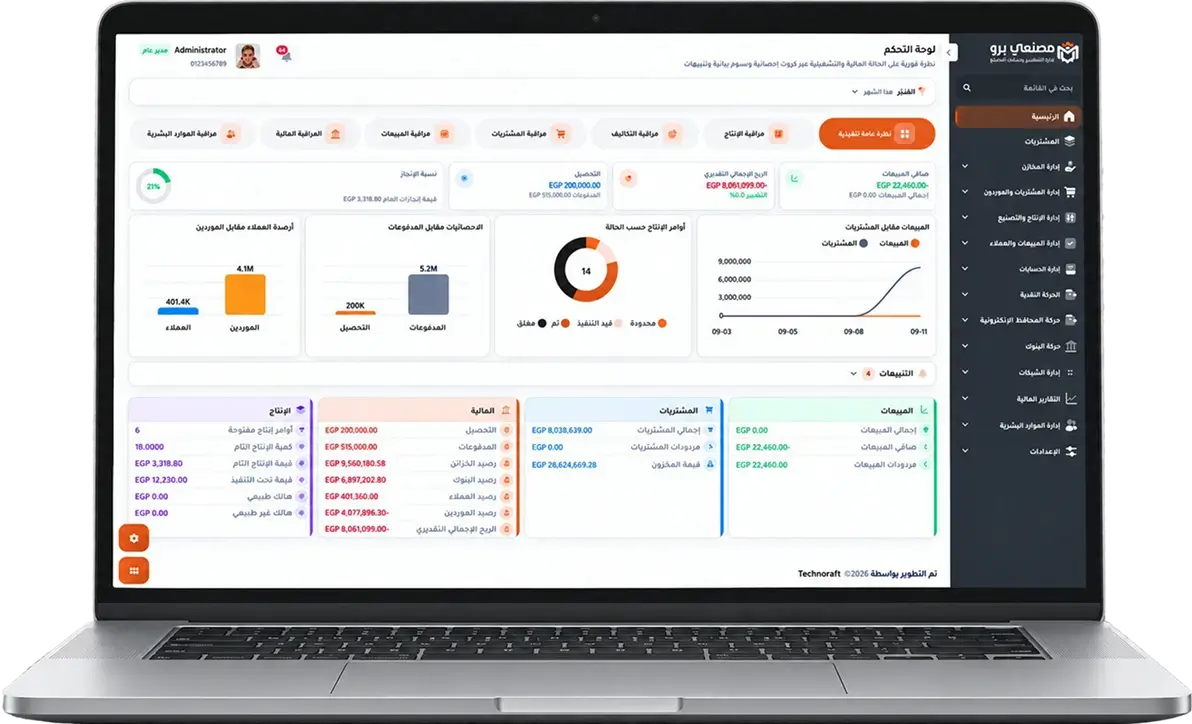

We understand model, size, and garment manufacturing challenges in your factory
Many colors and sizes, and work split across cutting, sewing, and finishing, make full-order follow-up harder.

Overlapping models and sizes
Required and produced quantities can diverge when every color and size is tracked in separate files.

Fabric consumption variances
It is hard to know why fabric use increased or how much waste came from cutting.

Bottlenecks between stages
Pieces can pile up in one stage while another stops, without a clear view for management.

Unclear model cost
It is hard to collect fabric, accessory, operating, and rework cost for every model.
Where is the unfinished quantity in a garment order?
A total production figure does not explain which garments are ready and which still need work. With several operating stages, the useful question is where the quantity stands now, without counting the same item repeatedly as it moves.
Masna3y Pro connects operating stages to work orders under a production order and tracks quantities and planned versus actual time. The review starts by distinguishing movement through a stage from the quantity currently at that stage. Those figures answer different questions.
Consider a fictional snapshot of a 200-piece order: 150 pieces are finished, 30 are in sewing and 20 are in finishing. These are separate states at the same instant. They total 200, with 50 still in progress. Adding earlier stage movements would double-count pieces. No monetary work-in-progress value is inferred from these quantities.
Report example: current quantity at each stage
Educational simulation with fictional quantities and references; not customer data or a system screenshot. The table illustrates how to read the data; it does not represent a ready-made sector report in this layout.
An illustrative snapshot of order SIM-TEX-200 for 200 pieces with sequential stages. Assume transferred quantities have reached the next stage, 150 pieces have been received as finished output, and there is no scrap, quality hold or rework in this snapshot.
| Stage | Input in example | Finished at stage | Currently inside |
|---|---|---|---|
| Sewing | 200 | 170 | 30 |
| Finishing | 170 | 150 | 20 |
Sewing: 200 − 170 = 30 pieces. Finishing: 170 − 150 = 20 pieces. With 150 finished pieces, the current total is 200, including 50 in progress. Do not add 170 and 150 as finished output: the same pieces passed through both stages. Scrap, inspection holds and quantities awaiting transfer must be shown separately when present.
See how order movements relate to production costing
Can I add every stage’s output to find the quantity remaining in an order?
No. The same piece may appear in several stage movements. Review its current state and distinguish finished output from quantities still in progress, rather than adding all earlier movements.
Does the system handle sizes and colors the way my factory needs?
We review how your factory defines items, sizes and colors before confirming scope. The review establishes whether the requirement is available in the system, needs suitable configuration, or requires a separately assessed customization.
Read about setup, training and support
Prepare a simple example of one order’s stages and the question you find difficult to answer. This helps define a relevant demonstration.
Garment and Textile Production Stages | Masna3y Pro
Review where garment-order quantities stand across operating stages and finished output, using a clearly fictional quantity example without double-counting.



